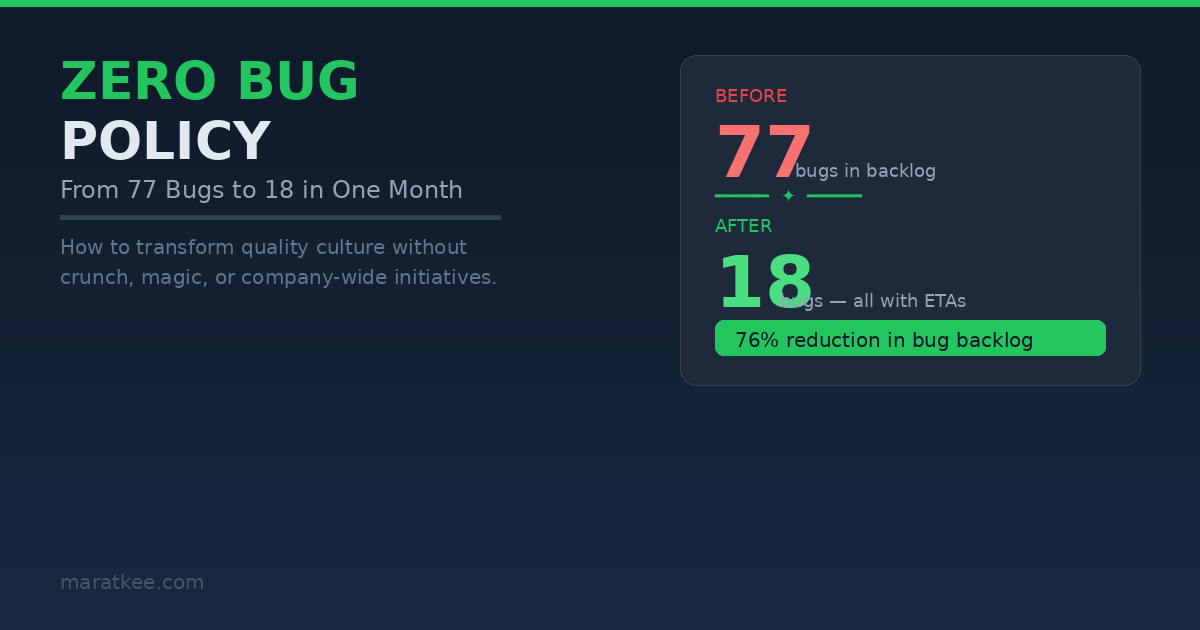
77 bugs in the backlog. 60 of them without any due date.
One month later: 18 bugs. Every single one with an ETA.
No magic. No crunch. Just a policy.

The Problem
How were bugs prioritized before?
Three criteria:
- Who screams loudest — the most frustrated stakeholder wins
- Which client has the biggest ARR — revenue drives priority
- How urgent it sounds — panic is contagious
The result? A chaotic queue, broken promises, customer-facing teams losing trust in engineering, and engineers trapped in constant context-switching.
Sound familiar?
The Solution: Zero Bug Policy
Simple rules, rigorously enforced.
Priority Levels
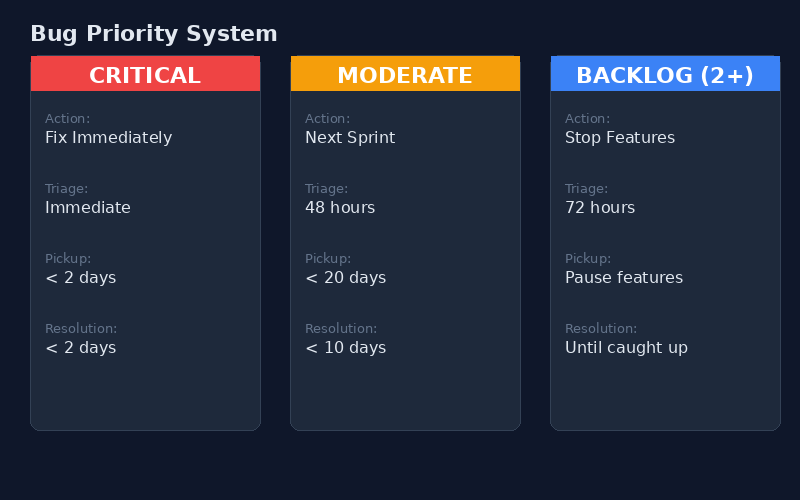
| Priority | Action |
|---|---|
| Critical | Drop everything. Fix immediately. |
| Moderate | Next sprint. 30% of capacity reserved. |
| Backlog > 2 sprints | Stop new features. Fix bugs until caught up. |
SLAs
| Type | Triage | Pickup | Resolution |
|---|---|---|---|
| Critical | Immediate | < 2 days | < 2 days |
| Moderate | 48 hours | ≤ 20 days | ≤ 10 days |
The Golden Rule
Every bug has a Due Date or an “ETA for ETA.”
No bug lives in the backlog without a commitment.
If we can’t commit to fixing it, we either:
- Close it (won’t fix)
- Escalate it (need resources)
- Schedule it (next quarter)
But we never leave it floating.

Why It Works
1. Predictability
The customer knows when to expect a fix. No more “we’ll get to it eventually.”
2. Transparency
Support and CSM teams see the real picture. They can set expectations with customers.
3. Discipline
The team can’t ignore quality. Bugs are first-class citizens, not afterthoughts.
Cleaning Dead Weight
Once you have a policy, you’ll notice something interesting:
Half your backlog is garbage.
Bugs that have been sitting for 6+ months without action. Features nobody asked for twice. Ideas that seemed good at the time.
The Dead Weight Audit:
Go through every item older than 90 days. For each one:
| Status | Action |
|---|---|
| Still relevant + actionable | Keep, assign due date |
| Relevant but unclear | Clarify with stakeholder this week |
| Nobody remembers why it’s here | Close |
| Superseded by other work | Close |
| Nice-to-have, no champion | Close |
In our case: 40% of the backlog was dead weight. Closing it freed mental space and made the real priorities visible.
The Capacity Allocation
Here’s how we split the sprint:
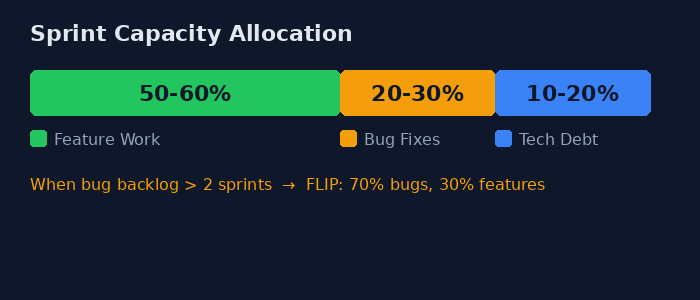
This isn’t negotiable. Every sprint, bugs get their slice.
When bug backlog exceeds 2 sprints of work at 30% capacity, we flip:
- Bugs get 70%
- Features get 30%
Until we’re caught up.
The Cultural Shift
The numbers (77 → 18) were impressive.
But the real change was cultural:
Before:
- Quality was an afterthought
- “We’ll fix it later” meant “never”
- Engineers dreaded bug duty
After:
- Quality became part of Definition of Done
- Bugs were addressed systematically
- Engineers saw impact immediately
As one stakeholder put it:
“Zero Bug Policy significantly bolstered the trust of teams interacting with customers.”
How to Start (4-Week Plan)
You don’t need a company-wide initiative. Start with your team.
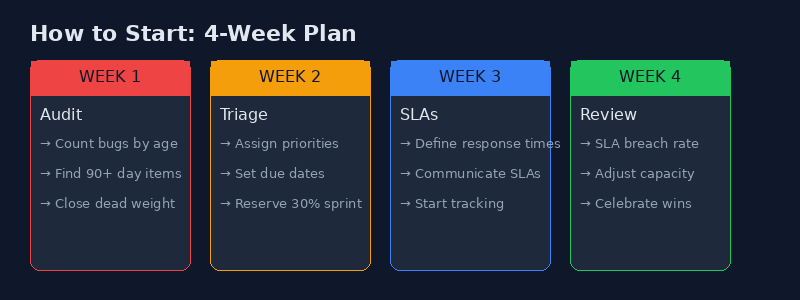
Week 1: Audit
- Count bugs by age
- Identify items > 90 days old
- Close dead weight (get stakeholder sign-off)
Week 2: Triage
- Assign priority to remaining bugs
- Set due dates (or ETA for ETA)
- Reserve 20-30% of next sprint for bugs
Week 3: SLAs
- Define response times by priority
- Communicate to stakeholders
- Start tracking SLA breach rate
Week 4: Review
- Check: how many bugs missed SLA?
- Adjust capacity if needed
- Celebrate wins
Metrics to Track
| Metric | What It Tells You |
|---|---|
| Bug count | Total open bugs |
| Age distribution | How many are rotting? |
| SLA breach rate | Are we keeping promises? |
| Time to triage | How fast do we respond? |
| Bugs per release | Is quality improving? |
Connection to the Triangle of Team Efficiency
Zero Bug Policy is a Flow practice (Pillar 3: Predictable Team).
But it only works when:
Pillar 1 (Goals): Quality is explicitly a priority. Leadership says “bugs matter” and means it.
Pillar 2 (People): Engineers aren’t afraid to report bugs. The Edmondson Paradox applies — if it’s unsafe to raise issues, bugs stay hidden.
Without goals and safety, Zero Bug Policy becomes empty process.
With them, it becomes a transformation.
Key Takeaways
- Every bug needs a Due Date or “ETA for ETA”
- Reserve 20-30% of sprint capacity for bugs
- When backlog exceeds 2 sprints: pause features, fix bugs
- Dead weight audit: close 90+ day items nobody champions
- Track SLA breach rate weekly
- The real win is cultural: quality becomes part of Definition of Done
Part of the Triangle of Team Efficiency series: The Triangle Model — The Edmondson Paradox