Product Engineer в гибридных IT-командах: паттерны перехода 2025-2026

Методология: Extended Search Research · 8 потоков · 17+ источников · 2025-2026 Классические фиче-команды и платформенные команды с переходом к Product Engineer проблем не вызывают: «все учат делать всё», стек однородный, AI-агенты подстраховывают. Проблемы начинаются в гибридных командах, где комбо из принципиально разных стеков: Прикладная разработка + дата-инженерия (Java + Trino/Airflow/ClickHouse) Прикладная + коробка + стриминг Карточный процессинг: Java + данные + COTS + персонализация Команда внутри разбивается по системам и стеку. И главный вопрос: как в такой конфигурации выглядит Product Engineer? ...

May 15, 2026 · 9 min · Marat Kiniabulatov

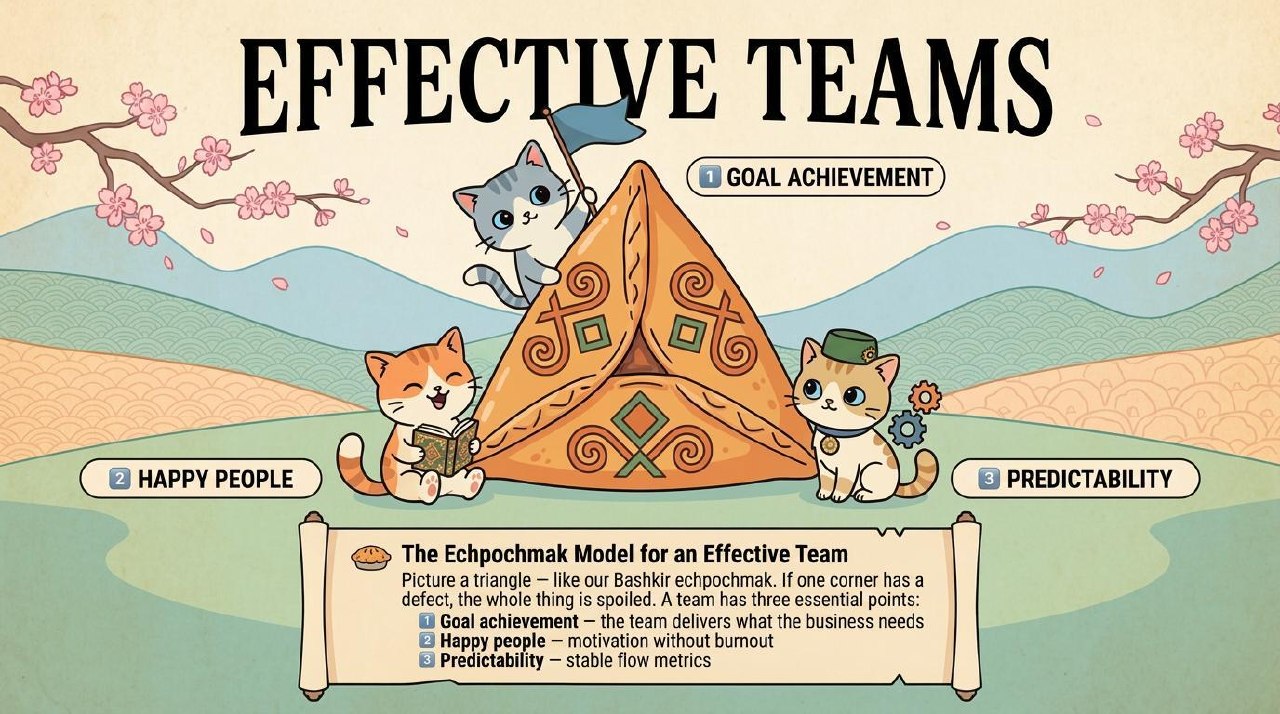
The Triangle of Team Efficiency: Goals, People, Flow

TL;DR: An effective team is one that: Achieves its business goals Maintains psychological safety and team motivation Delivers predictably through stable flow metrics Three pillars. One triangle. The Premise Two fintech teams spent three months building limit management systems in parallel. One for credit cards, one for checking accounts. Each team: 7–8 people, costing ~$100K/month (average US/EU engineering salary $120–150K/year per person, fully loaded). At the quarterly review, they discovered 70% functional overlap. ...

May 15, 2026 · 7 min · Marat Kiniabulatov
Zero Bug Policy cover

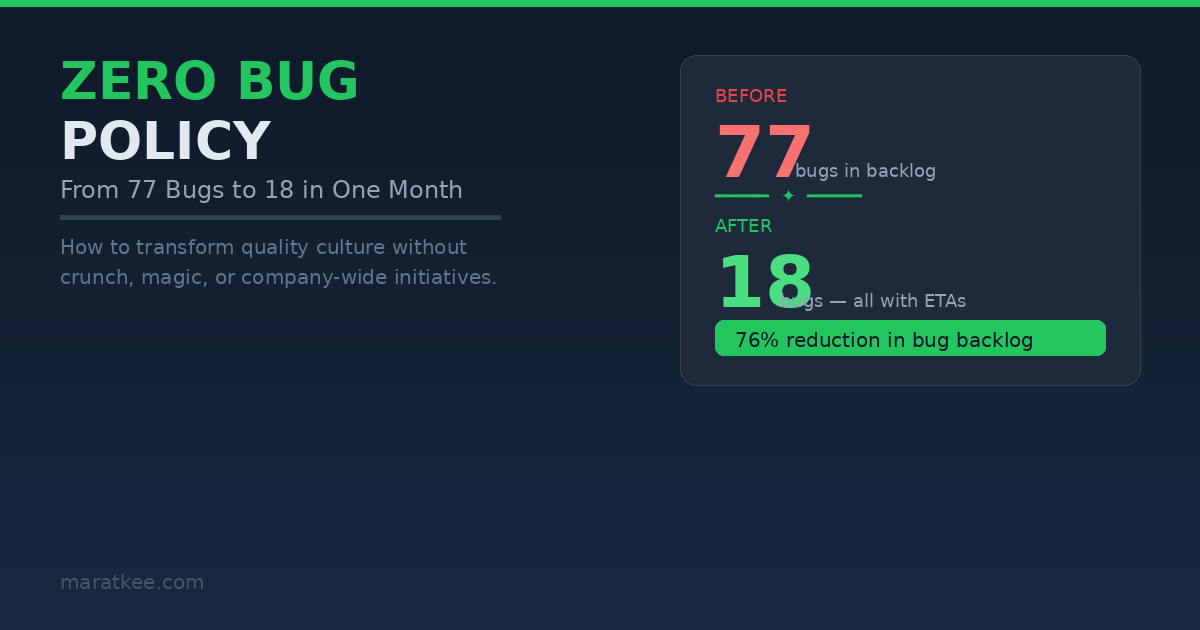
Zero Bug Policy: From 77 Bugs to 18 in One Month

77 bugs in the backlog. 60 of them without any due date. One month later: 18 bugs. Every single one with an ETA. No magic. No crunch. Just a policy. The Problem How were bugs prioritized before? Three criteria: Who screams loudest — the most frustrated stakeholder wins Which client has the biggest ARR — revenue drives priority How urgent it sounds — panic is contagious The result? A chaotic queue, broken promises, customer-facing teams losing trust in engineering, and engineers trapped in constant context-switching. ...

May 15, 2026 · 4 min · Marat Kiniabulatov

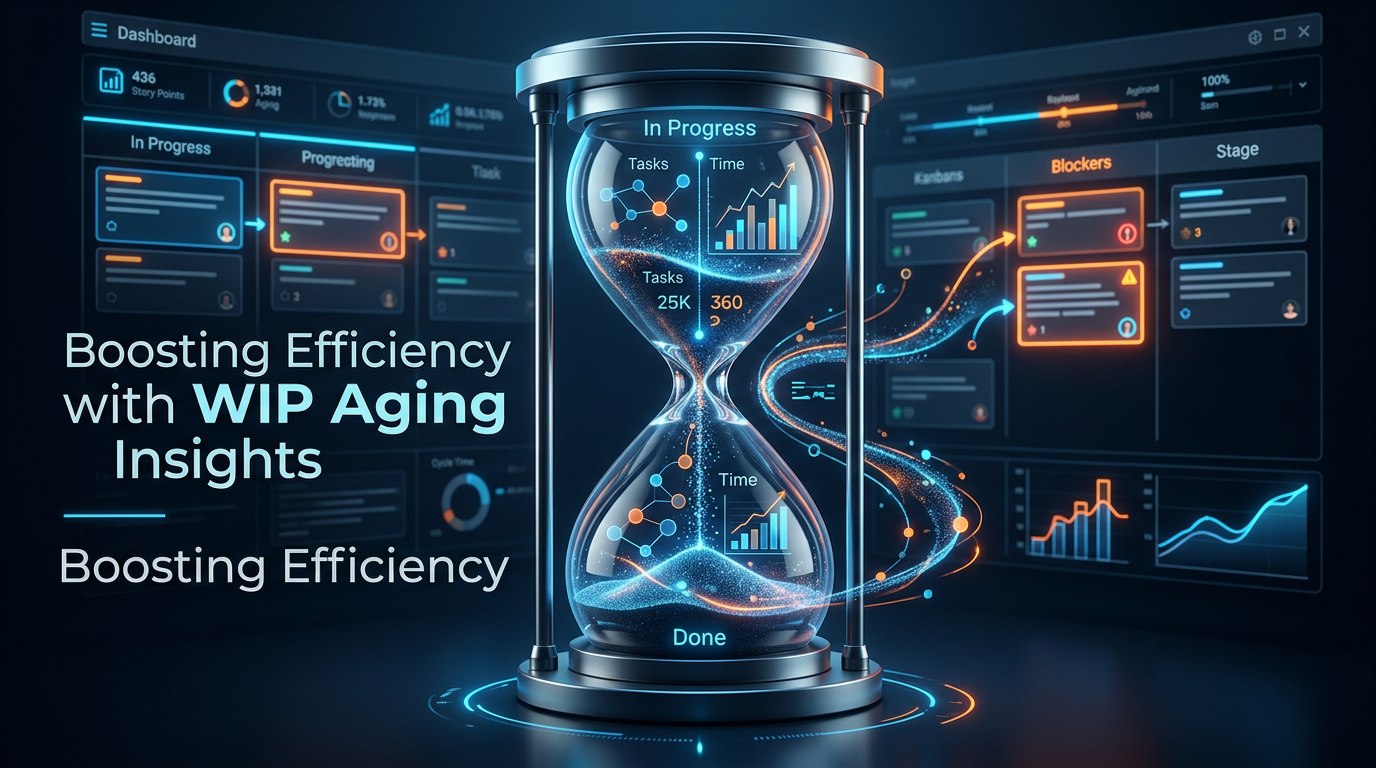
Boosting Efficiency with WIP Aging Insights and Tools

When examining real workflow data, there’s a common pattern: clusters of tasks that have aged significantly, some clearly stagnating beyond recognition acceptable timeframes. These cases point to one of the most important yet very often overlooked metrics in flow management: WIP Aging. WIP (Work In Progress) Aging measures the elapsed time that a work item has spent in active progress but remains incomplete. This metric serves as an early warning system for workflow problems, helping teams identify where work gets stuck before it significantly impacts delivery timelines. Unlike cycle time, which analyzes completed tasks retrospectively, WIP Aging provides real-time visibility into current work, making it the single most actionable metric for proactive flow management. ...

October 29, 2025 · 7 min · Marat Kiniabulatov

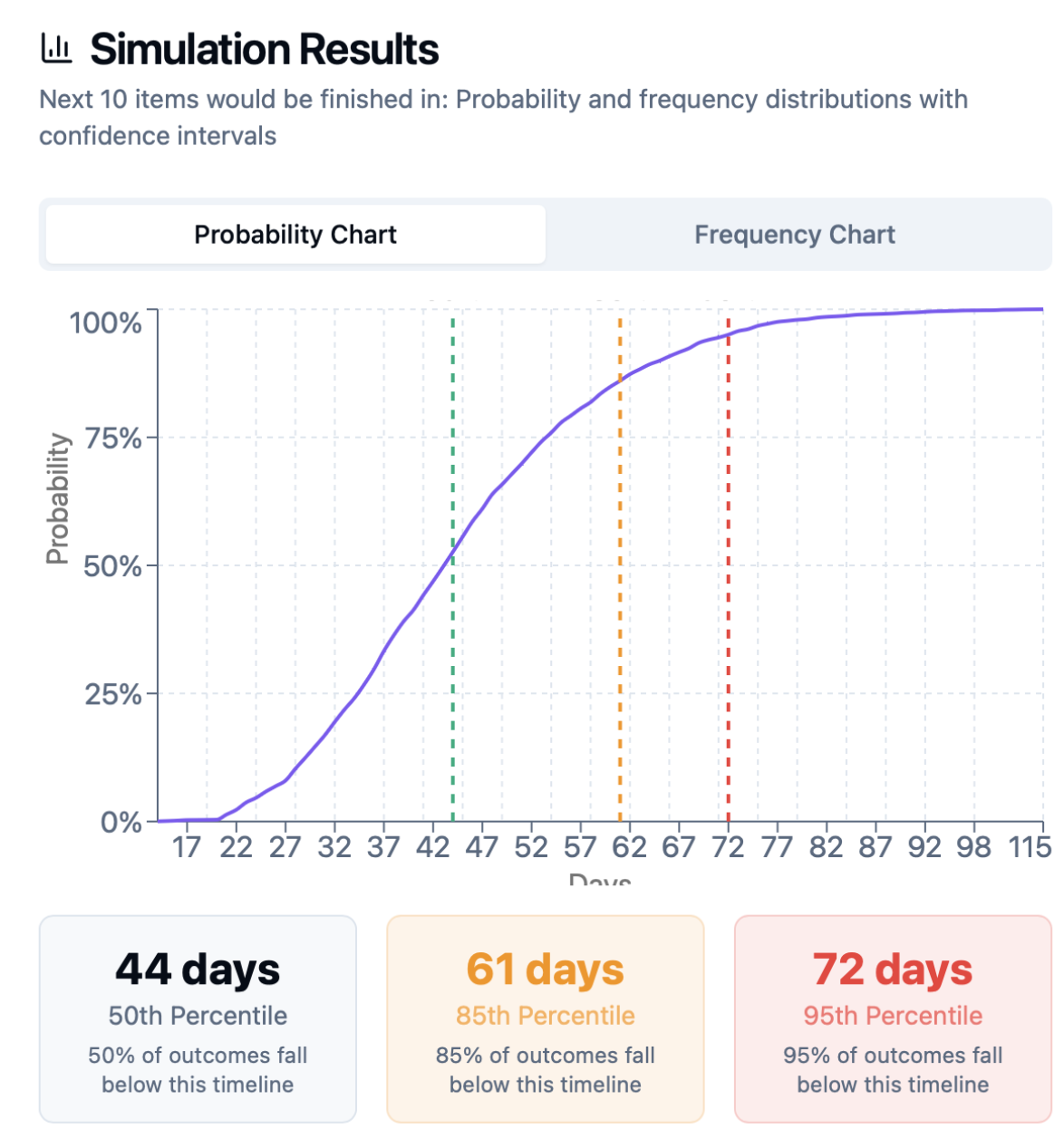
Monte Carlo Simulation: Forecasting Throughput and Project Timelines

TL;DR: Forecasting team Throughput is super-easy and much more reliable than traditional methods, if you limit your work in Progress. Reliability confirmed by research data. We’ve already extensively covered Throughput (one of the flow metrics), how to analyze Throughput data from 3 key angles. And why it’s better for forecasting than storypoints. Now let’s get to essentials and practical questions that our management looooves to ask: “When will you guys finish this project of X items”? ...

September 16, 2025 · 5 min · Marat Kiniabulatov

3 key data slices to understand your team's Predictability through Throughput (pun intended).

Today we’ll talk about Throughput metric. Why is it so important, how to read it’s patterns and what to be cautious about. Premise Imagine walking into a bar on a Friday evening, exhausted, and ordering a beer flight. The bartender thinks: “Over the past hour we completed 12 orders; there are 4 in progress; this will be the fifth. Your flight will arrive in 20–25 minutes.” There are no subjective complexity estimates - only historical data to forecast wait time. Wouldn’t it be great if an IT team could plan as simply, honestly, and predictably? Ha-ha, you wish ...

September 10, 2025 · 6 min · Marat Kiniabulatov

5 Reasons Why Your Story Points Aren't Working (And What to Do About It)

Over seven years of running Story Points workshops, I’ve seen the same pattern: teams learn the technique, apply it for a few sprints, then gradually drift back to old habits. At my current scale — 47 teams, around 400 people in IT — 60% use Story Points, 40% don’t. What’s interesting: those 60% who do use them do it completely differently. Even 3 months after the training, only 20-30% use Story Points correctly (as intended). The problem isn’t the tool itself, but how we use it and what we expect from it. ...

June 26, 2025 · 5 min · Marat Kiniabulatov

Product Operations: simple steps to build transparent Feature Pipeline to dramatically lower Lead Time

(Experience from an AI-Based Fintech KYC SaaS Startup Focused on LATAM and Africa) Your regular challenge: When Sales, Marketing and IT Speak Different Languages Our SaaS startup served emerging fast-paced fintech markets (it still is). Speed + compliance were existential. Since most startups live on venture capital with limited runway, every delay in shipping value to the market means lost clients and regulatory risk. It also a huge roadblock on your path to become self-sustainable. So you need to be super frugal and efficient. ...

May 7, 2024 · 7 min · Marat Kiniabulatov

My experience in preparing to PSM II (Professional Scrum Master) certification

Hey everyone, here’s my list of resources and literature for getting prepped for the PSM II examination. I would be tremendously happy if you share yours :) *Sidenote: if you are “certificates are overvalued” type of person - I’d agree. This is especially true when it comes to CSM / PSM I - because that certification only mentions that you have been introduced to the basics. However, when it comes to PSM II you need to rely on your experience as a Scrum Master. No more “shu” (of shu-ha-ri), just your experience and daily understanding of agile values. * ...

June 1, 2020 · 11 min · Marat Kiniabulatov

Trust Stories - Growing trust in distributed teams (RU)

Last week me and Alex Pikulev of Agilix recorded Trust Stories podcast episode, on Growing Team Trust in Distributed Teams. Courtesy of In Teams we Trust website https://www.youtube.com/watch?v=Pq82aFap1rc Main bullets are: Growing trust in distrubited teams is hard, but nevertheless as important as in co-located team. Team itself creates an atmosphere of trust in itself. Our task, as a scrum master, coach, manager - is to help and highlight needed areas. XP and especially Pair Programmingи helps in growing trust. Intrateam trust, from the informal side (skype beers, navigating as a guest to your colleagues in other locations, bike fixing via the webcam, ordering stuff on flea market in your city and sending it over to a colleague) helps a lot. More freedom for the team, for collaborative work and motivation. More trust! Work harder on understanding the context and value of features implemented. More details (rus) / tg channel : https://t.me/inteamwetrust_rus/35 Video: https://youtu.be/Pq82aFap1rc

July 8, 2019 · 1 min · Marat Kiniabulatov