Fast Agents, Slow Decisions: How Teams Recreate Waterfall at AI Speed

A coding agent can turn a detailed plan into code, tests, configuration, and infrastructure before the next planning meeting. That can reduce the time and effort needed for implementation. It does not settle whether the team chose the right problem, has permission to use the data, understands the operational consequences, or can release the change safely. That gap can make a familiar delivery failure happen sooner. The risk is easy to miss because the first result looks convincing. The pull request is large. The test suite is green. The service starts. People can demo it. By then, a team may have invested enough in one approach that changing direction feels costly or politically difficult. ...


September 11, 2026 · 7 min · Marat Kiniabulatov
Three engineers work above the platform, automated checks, and specialist support that make a tiny team viable.

The Human Loop Monthly #2 — Tiny Teams With AI: What the Evidence Shows—and What It Still Doesn’t

AI can make a small team more capable. Public evidence still does not show that three-person AI-native teams outperform well-designed cross-functional teams at scale. The data supports local acceleration: research, coding, testing, and delivery activity can all move faster. It does not establish a universal optimal team size. This article maps the four conditions that determine whether a team of two or three can work sustainably—and two stress tests that reveal where it will break first. ...

August 24, 2026 · 13 min · Marat Kiniabulatov
A giant cat sitting in a traffic jam, illustrating a bottleneck in the path to production

Agentic Engineering Is Not About Agents. It Is About the Path to Production

We went from early LLM experiments to broad use of chats and coding agents across a large engineering organization at Raiffeisenbank. This article is based on Raiffeisenbank’s experience adopting LLM tools and coding agents across roughly 500 engineers. On the adoption dashboards, everything looked healthy: people opened the tools, tried them, came back, brought examples, showed demos, and tech leads helped their teams learn. The flow metrics did not move for a long time. ...

June 15, 2026 · 16 min · Marat Kiniabulatov
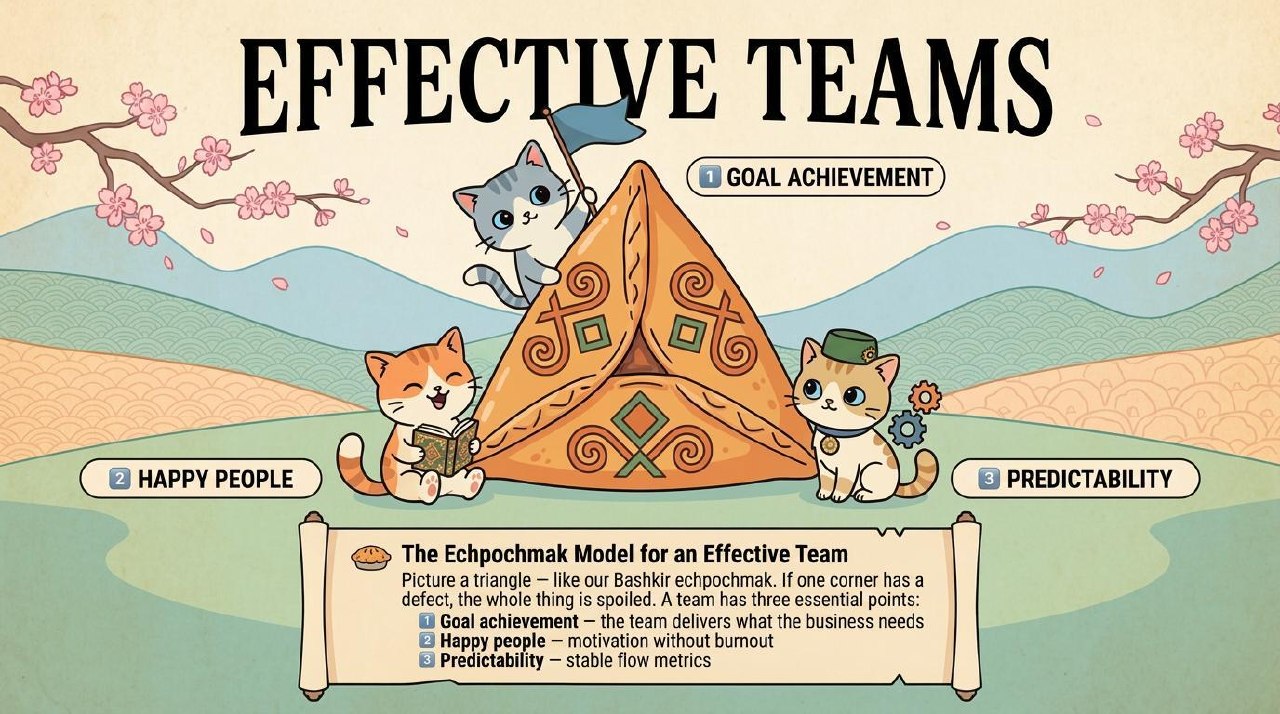
Effective Teams: the Echpochmak model with goal achievement, happy people, and predictability

The Triangle of Team Efficiency: Goals, People, Flow

TL;DR: An effective team is one that: Achieves its business goals Maintains psychological safety and team motivation Delivers predictably through stable flow metrics Three pillars. One triangle. The Premise Two fintech teams spent three months building limit management systems in parallel. One for credit cards, one for checking accounts. Each team: 7–8 people, costing ~$100K/month (average US/EU engineering salary $120–150K/year per person, fully loaded). At the quarterly review, they discovered 70% functional overlap. ...

May 15, 2026 · 7 min · Marat Kiniabulatov
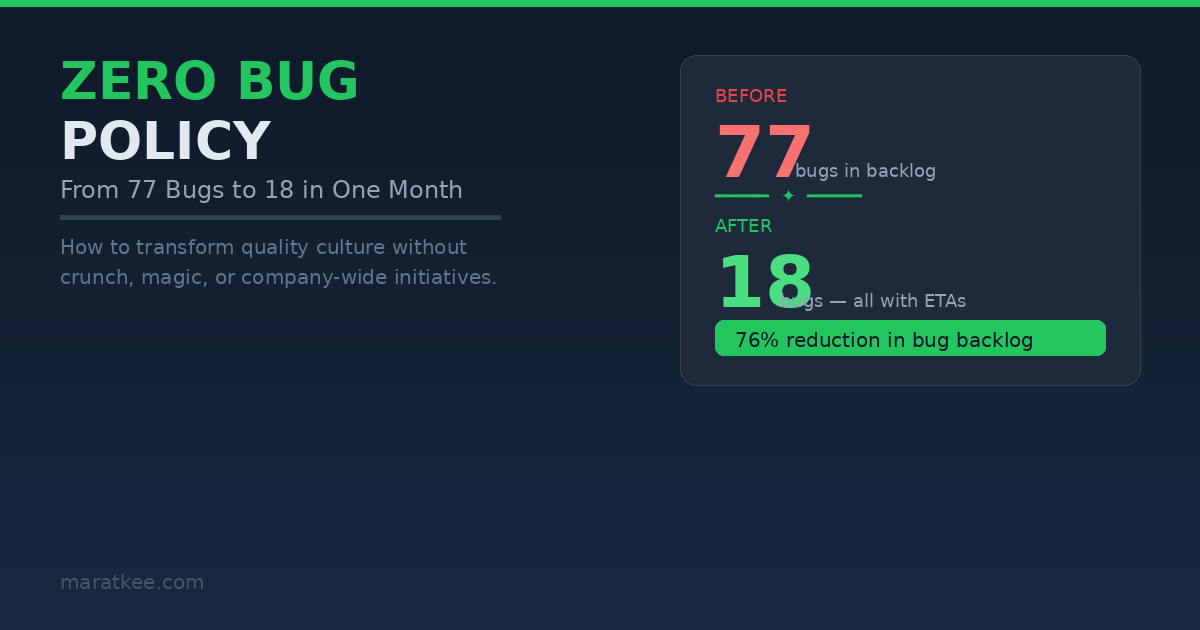
Zero Bug Policy cover

Zero Bug Policy: From 77 Bugs to 18 in One Month

77 bugs in the backlog. 60 of them without any due date. One month later: 18 bugs. Every single one with an ETA. No magic. No crunch. Just a policy. The Problem How were bugs prioritized before? Three criteria: Who screams loudest — the most frustrated stakeholder wins Which client has the biggest ARR — revenue drives priority How urgent it sounds — panic is contagious The result? A chaotic queue, broken promises, customer-facing teams losing trust in engineering, and engineers trapped in constant context-switching. ...

May 15, 2026 · 4 min · Marat Kiniabulatov